
https://www.fnesc.ca/first-peoples-principles-of-learning/
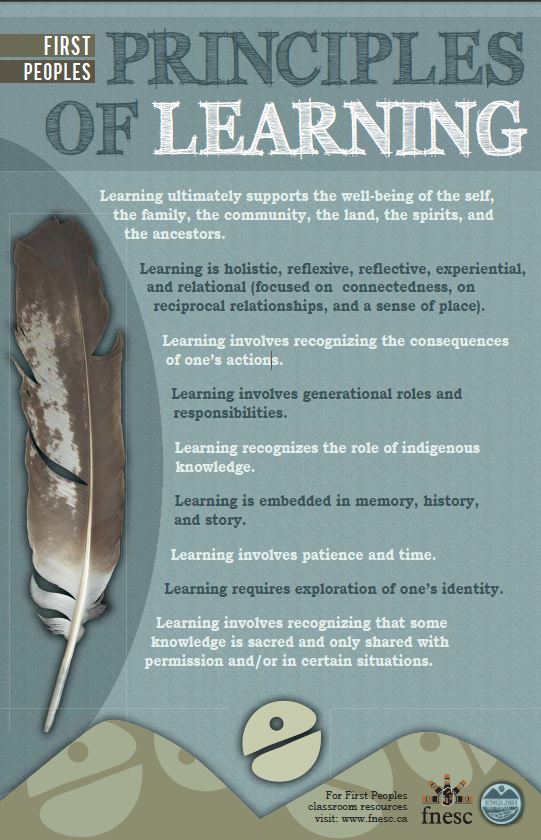
As our province and country moves towards reconciliation with our Indigenous communities for the past atrocities that have occurred, the First Peoples Principles of Learning is important to embed into our teaching practices. Many children in classrooms today, do not learn well in the traditional colonial ways. In fact, a lot of us never did but it was all we knew so we had to adjust to survive. In many ways, I find it hard to change my own way of learning because it was so deeply engrained into me: Lecture, read textbook, memorize, and do a test to receive a grade. This is not the true way to evaluate our students. The First Peoples Principles of Learning expresses that there are so many more ways to assess a child’s learning and understanding. It is important that as educators, we take the time and have the patience to gather more assessment and see students from different perspectives. Many students that do not “test” well have far more intelligence and understanding than was traditionally thought. We are all diverse learners and it’s important that educators see and understand that. It’s also important that we acknowledge that some information is sacred and is not ours to share. In these cases, an Indigenous Knowledge Keeper, Elder, or Aboriginal Support Worker (ASW) should be the ones sharing these stories and history. In a nutshell, the First Peoples Principles of Learning tells a story that all culture is important and needs to be respected as we are all diverse individuals.